CROSS-BORDER DISPUTE? SHOULD YOU CHOOSE ARBITRATION OR COURT? A FOUNDER’S PRACTICAL GUIDE (2025 GLOBAL EDITION)
Read More
Remote Work & Freelancer Contracts: What US, Australian & Indian Businesses Need in 2025
By the SolvLegal Team
Published on: Nov. 14, 2025, 12:43 p.m.
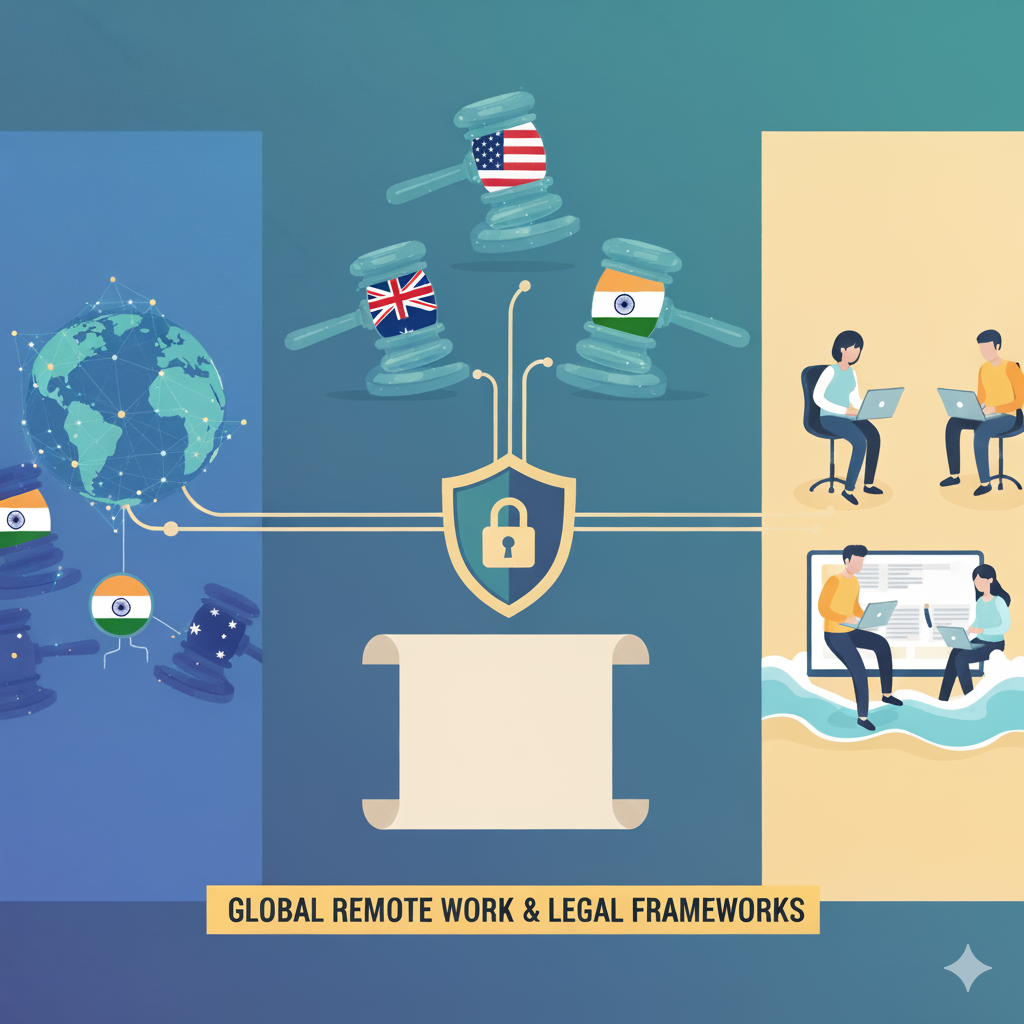
The Global Remote Work Boom & the Need for Solid Freelancer Contracts
Remote work isn’t a post-pandemic experiment anymore, it’s the cornerstone of modern business in 2025. Across countries like the US, Australia, and India, businesses are rapidly creating global teams powered by freelancers and independent contractors.
By 2019, digital opportunities had already made remote work more accessible than ever. However, a number of obstacles continued to hinder potential remote workers, including cultural norms, regulatory requirement and technological limitations. This reality was drastically altered by the COVID-19. Businesses were compelled to develop quickly and make significant investment in digital infrastructure and communication tools like Slack and Zoom when closing down operations was no longer an option.
Data from the World Economic Forum, which projects that by 2030, number of digital jobs and freelance positions worldwide will increase by around 25% to over 92 million, This shift spans various profession for example paralegals, insurance investigators, graphic designers etc, reflecting how pervasive remote collaboration has become in all sectors. This new model offers cost-efficiency and flexibility, but it also presents difficult legal issues. These days businesses have to deal with difficulties related to intellectual property rights, confidentiality or non-disclosure agreements, termination clauses, indemnity, liability and most importantly governing law and jurisdiction. As a result, well written, unambiguous contracts are now crucial for both remote work agreements (for long-term virtual employees) and freelancer contracts (for independent contractors). They guarantee compliance and safeguard the interests of both parties by defining ownership, deliverables, obligations and conflict resolution procedures.
This blog examines what businesses hiring remote workers or freelancers across borders must know when drafting compliant, enforceable agreements and how legal startups like Solvlegal are simplifying the process with innovative digital solutions.
Understanding Freelancer & Independent Contractor
Although the terms of freelancer and independent contractor are often used interchangeably they differ in nature. A freelancer is basically a self-employed individual who works on multiple short-term or project based assignments for various clients simultaneously. Their work arrangement are usually informal, with significant flexibility in determining how, when, and where to perform tasks, and payments are often made per task or project.
An independent contractor, on the other hand, works under a formal, legally binding contract with strictly defined terms, such as scope of work, project deliverables, payment schedule, and ownership rights regarding work. They may work as individual or registered business entities and are often engaged for specific or longer-term projects. In essence, all independent contractors are essentially freelancers, however not all independent contractors are freelancers. Main differences between them are the flexibility regarding their, work arrangement and their interaction with the customer. However, in most countries, freelancers falls under the ambit of regulations related to independent contractors.
Legal Compliance Landscape: US, Australia & India Compared
United States
In USA, employers managing remote workers must comply with various federal and state laws. One of them is The Fair Labor Standards Act (FLSA) which applies to remote workers. Under this act employers must ensure:
1. Minimum wage: Remote nonexempt workers must receive at least the federal minimum wage, regardless of location.
2. Overtime compensation: It is available to nonexempt workers who put in more than 40 hours a week, including remote work.
3. Meal and rest breaks: Employers are not required to provide meal or rest breaks. However, breaks lasting 5 to 20 minutes are considered compensable work hours. Meal breaks lasting more than 30 minutes are usually unpaid.
4. Workers' compensation: While the FLSA does not speak to worker’s compensation requirements, and workers’ compensation laws for remote workers may differ from one state to another, employers are generally required to cover employees for work-related injuries, even when they work from home.
5. Health and safety: Workplace safety protocols must be communicated to remote workers.
6. Anti-discrimination laws: Remote workers are entitled to the same protections against discrimination and harassment as onsite workers.
7. Payroll tax withholding: Employers must consider where an employee physically works to ensure compliance with state-specific tax obligations, such as income tax and unemployment Insurance.
8. Leave entitlements: Remote workers may be entitled to paid time off and up to 12 weeks of unpaid medical leave under the Family and Medical Leave Act (FMLA).
Employers must comply with the state specific law also for example California Labor Code Section 2802, clearly states that employers managing remote employees must reimburse employees for any reasonable and necessary remote work expense, such as internet and phone bills, office supplies, and work-related equipment and the New York’s Paid Family Leave which provides partial wage during family care or bonding time.
Worker misclassification as an independent contractor is a major issue for an employer which can lead to penalties and tax liabilities. To rectify this businesses or employers can correct misclassification through the Voluntary Classification Settlement Program (VSCP) by filling Form 8952 for future tax compliance. Freelancers, on the other hand, are not governed by any specific federal legislation in USA. However, they can establish their own rights and obligations through well-drafted contracts that clearly define key terms, including (but not limited to) payment terms, scope of services, project timelines and deadlines, legal remedies, governing law, intellectual property rights, termination provisions, insurance requirements, and indemnity clauses.
Additionally laws like Freelance Worker Protection Act in State of California has clearly defined that when a hiring parties with business in California hires or engages a freelancer residing in the same state. Any work worth $250 or more must be governed by a written contract and payments must be made on or before the due date, or within 30 days of completion if no date is specified. This Act also prohibits retaliation or discrimination against freelancers who assert their rights or file complaints. In cases of violation, freelancers can sue for damages, attorneys’ fees, injunctive relief and any other remedies deemed appropriate by the court, with penalties reaching up to twice the unpaid amount or $1,000 for refusal to provide a written contract.
Australia
In Australia, Fair Work Act 2009 applies to the remote workers. Most of its provisions are similar to what we had discussed in the FLSA, like duty of the employer to ensure the health and safety of remote workers including their mental health, etc. Under this act Employers must maintain flexible work hours, breaks and also identify psychological hazards like isolation, high job demands through measures like regular check-ins and access to employee assistance program. Additionally, certain employees who have worked with the employer for at least 12 months and regular casual employees who have worked with the employer regularly and systematically for at least 12 months and have a reasonable expectation of continuing doing, can request flexibility on working arrangement. These includes employees who are:
1. Pregnant
2. A parent of, or has responsibility for the care of, a child who is school age or younger
3. A carer (within the meaning of the Carer Recognition Act 2010)
4. A person with disability
5. Aged 55 or older
6. Experiencing family and domestic violence, or
7. Providing care or support to someone facing domestic violence
Employers must respond to a request for flexible working arrangements within 21 days of a request in writing. Either approving or refusing the request (with reasonable reasons) or setting out agreed alternative arrangements. An employer can only refuse a request if they have reasonable grounds to do so, after discussing the request and genuinely trying to find a solution. This provision was also reaffirmed in the decision of Charles Gregory Gregory v Maxxia Pty Ltd.
In the case of independent contractors, it is essential to ensure compliance with the Independent Contractor Act 2006, which aims to promote fairness and prevent contracts that are harsh, unjust, or contrary to public policy. The Act ensures that agreements with independent contractors align with Australian industrial laws. It should also be noted that many provisions of Fair Work Act is also applicable to independent contractors in Australia to safeguard and protect them.
India
Unlike the United States and Australia, which have different regulations for remote workers and independent contractors, India lacks such kind of regulations or statute to deal with both of these working arrangements. However, India is in the process of codifying several of its national-level labour laws into four codes, and one of the labour codes in this regard is the Industrial Relations Code, 2020 (the provisions of which are yet to be made effective). This code contains provisions relating to Standing Orders that mandate employers in certain establishments to adopt certain work rules for their employees with the consent of their workers. The draft model Standing Orders proposed by the union government, as was published by the Ministry of Labour and Employment in January 2021 contains a reference to “work-from-home” arrangements for employers in the services sector. In India, the Employers must consider labour, tax, health and social security compliance and its possible implication under various laws such as Employees Provident Fund and Miscellaneous Provisions Act, 1952, Employees’ Compensation Act. 1923, Mental Healthcare Act, 2017 and Maternity Benefit Act, 1961. The Supreme Court’s decision in Rakesh Kumar Verma vs. HDFC Bank Ltd further affirms the enforceability of exclusive jurisdiction clauses in private employment contracts which was not the case earlier, This ruling may have broader implications for how such clauses are interpreted in agreements with independent contractors and remote workers in the future, potentially creating new legal disputes for contracting or hiring parties.
When drafting remote work or freelance agreements, it’s important to ensure that the contract follows the Indian Contract Act, 1872, and other relevant laws. The agreement should be carefully drafted to include key clauses on intellectual property, confidentiality, taxation, and social security. It’s also essential to comply with the Digital Personal Data Protection Act, 2023, to make sure personal data is handled responsibly and to protect individuals from any potential loss or liability.
Across countries like USA, Australia and India intellectual property rights remains one of the most crucial aspects of the business and it is also important to remember that contract itself mostly governs intellectual property rights in most of the contractual arrangements. Therefore, in order to prevent uncertainty all parties should carefully include IP clauses to avoid ambiguity and ensure compliance with applicable laws. It will not only prevents disputes but will also make operations smoother and more profitable.
How Legal Startups Empower Global Compliance in Remote Work Contracts
In 2025, legal startups are transforming how businesses handle remote work and freelancer contracts across globe. With businesses in the Australia, U.S., and India are increasingly hiring remote professionals, maintaining regulatory compliance in multiple countries is no longer optional, it’s a necessity. Legal startups like SolvLegal bridge the gap between speed and compliance by providing tools that make global hiring both efficient, safe and legally secure. They provide templates for freelance and remote work contracts that are country-specific, guaranteeing clarity on obligations regarding confidentiality, payment terms, data security and intellectual property rights.
These startups run compliance checks covering tax regulations, data privacy, and cross-border intellectual property ownership. This is important because, as highlighted by Wolters Kluwer’s 2024 article, firms who have remote teams must deal with a variety of complicated issues stated above. Legal startups simplify these complexities through legal vetting, ensuring every remote or freelancer agreement meets local and international standards. Many firms also provide continuous retainer models, allowing startup entrepreneurs and small businesses to manage global teams without any legal risks.
Frequently Asked Questions (FAQs)
Q1) What is the difference between a freelancer and an independent contractor in a legal context?
Ans) A freelancer is typically a self-employed individual who takes on multiple, short-term assignments with high flexibility in their work arrangement. An independent contractor works under a formal, legally binding contract with strictly defined terms, such as scope of work, payment schedules, and ownership rights, often for specific or longer-term projects.
Q2) What regulations govern remote work and freelancer contracts in India?
Ans) India lacks a union law governing remote work or freelance arrangements; however, such engagements must comply with the Indian Contract Act, relevant labor laws, and data protection requirements under the Digital Personal Data Protection Act, 2023. Key contractual clauses should address intellectual property, confidentiality, taxation, social security, and compliance with applicable employment statutes. Contracts should be drafted with clarity and precision to prevent potential disputes.
Q3) How do intellectual property rights work in freelancer agreements across the US, Australia, and India?
Ans) Intellectual property rights are governed by explicit contractual clauses in all three countries. Agreements should include clear ownership, licensing, and assignment provisions tailored to the relevant jurisdiction to protect business interests and prevent disputes. It is essential to specify who owns the work product, define usage limitations, and ensure compliance with both country-specific laws and international standards.
Q4) What are common mistakes employers make when hiring freelancers across borders?
Ans) Typical mistakes include unclear scope of work, missing written contracts, late payments, ignoring tax or local employment laws, failing to protect IP, and neglecting compliance with anti-discrimination or data privacy regulations.
Q5) How are legal startups helping employers with global compliance?
Ans) Legal startups like SolvLegal provide jurisdiction-specific contract templates, compliance checks, and contract vetting. They ensure remote working or freelancer agreements comply with regional laws and data regulations across the US, Australia, and India.
Author: Priyansh Tiwari is a 2nd year law student at Maharashtra National Law University Chhatrapati Sambhajinagar.
Reviewed by
This article was reviewed by Prakhar Rai, a seasoned corporate lawyer. He advises extensively on intellectual property, contracts, mergers and acquisitions, and private equity and venture capital. His work also includes data protection and privacy, regulatory and compliance advisory, white-collar crime, technology and startup law, and commercial dispute resolution.

Related Articles


Leave a Comment